XIMNET - The Leading Tech Agency In Malaysia
From Reading to Talking: How AI Shifts The Way Users Interact with Your Website
How do you look up for answers?

You typed what you wanted in plain language on ChatGPT or Google Gemini, and got a direct, tailored answer. You could ask a follow-up, and it remembered what you'd just said.

Now think about what happens when you land on a typical company website. You scan menus, guess which page holds the answer, type a keyword into a search box that returns ten loosely related links, and open a 30-page PDF hoping the answer is on page 19.

Both experiences sit in the same browser, and visitors notice the gap. Increasingly, they won't tolerate it.

The way people find and use information has changed.
1. Discovery is moving from search results to answers.

Search engines used to send people to your website. Now AI-driven tools such as AI Overviews, ChatGPT, Gemini and Perplexity increasingly answer the question themselves, drawing on content from websites like yours. That's why two new ideas have joined SEO in the marketing vocabulary:

  • AEO (Answer Engine Optimisation): structuring your content so it can be understood and used as the direct answer to a question.
  • GEO (Generative Engine Optimisation): making your content easy for generative AI systems to interpret, trust and cite.

Both reward clear, well-organised, genuinely useful content. But they only cover the first half of the story: how people arrive.

2. Expectations inside your website have changed too.

Once visitors arrive, they bring their AI habits with them. They expect to ask rather than hunt. They expect answers shaped to their situation rather than a generic page written for everyone. They expect the interaction to be active, not passive.

A website that only publishes content is a library with no librarian. The opportunity now is to give your site the intelligence people already enjoy elsewhere, grounded in your content, your rules and your brand.

That is what "AI for your website" means.


Five ways AI can make your website more useful

XTOPIA builds AI tools designed for exactly this. Here are the core building blocks, plus a few ideas beyond them.
1. AI Agent: a front desk that never closes

An AI Agent is more than a chatbot that recites FAQs. XTOPIA's agents learn from your website and documents, answer in your context, and can take action: booking appointments, qualifying leads, routing cases or handling voice conversations.

Under the hood, XTOPIA uses retrieval-augmented generation (RAG), which keeps answers grounded in your own content rather than the open internet. Guardrails, auditable action logs and human-escalation points keep you in control. Setup is codeless: a code snippet on your website, trained on your site and documents.

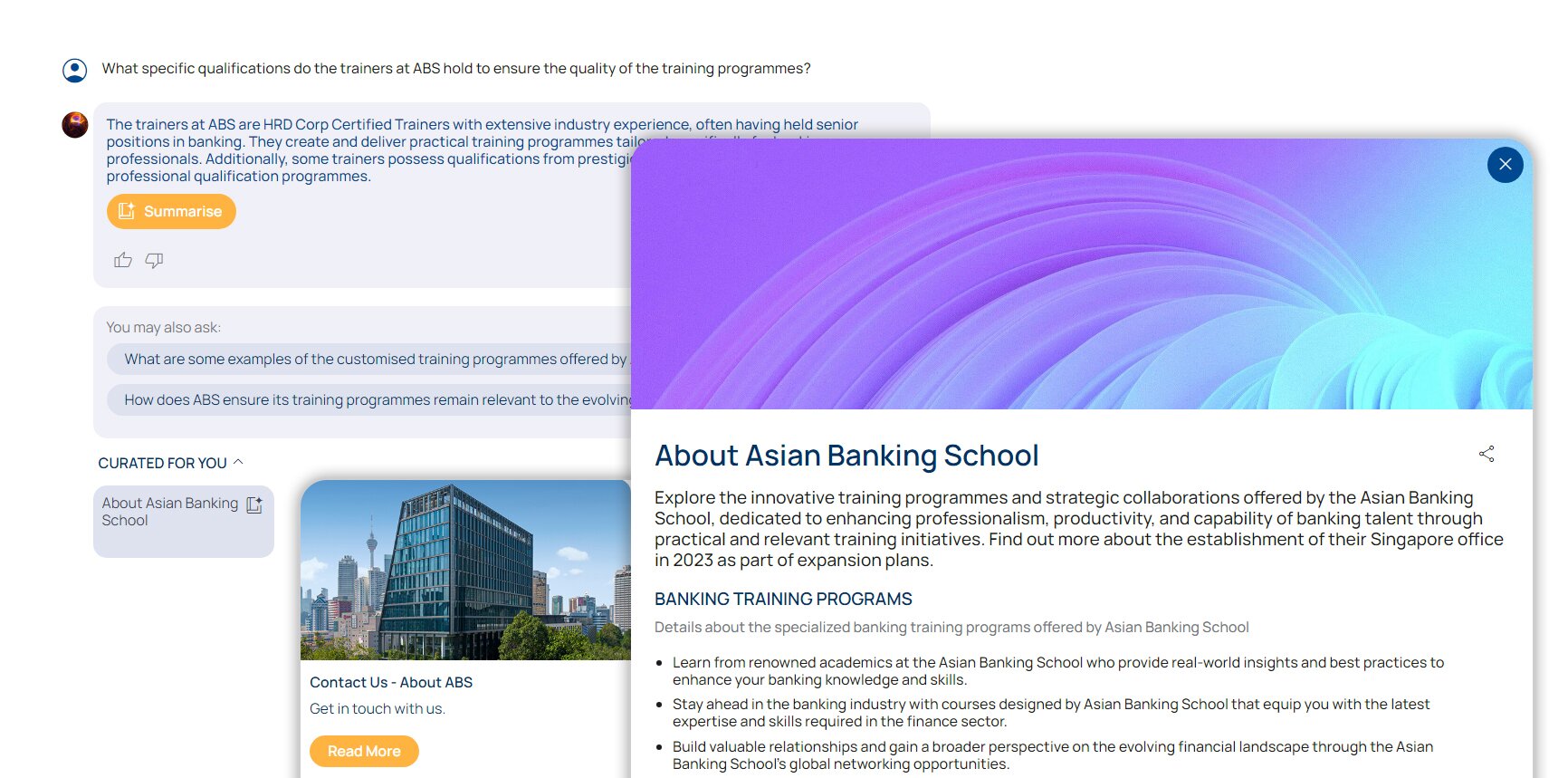
Asian Banking School's AI assistant, Abby, is a real example. It answers visitor questions without extra training materials, compares programmes, and points people to the right pages for more detail.

AI Agent is best for customer enquiries, bookings, lead capture, onboarding, internal helpdesks.

How AI Agent or commonly known as Chatbot interacts on website like Asian Banking School

Illustrative Sample: The boutique hotel that answers like a concierge

A small hotel group gets the same questions every day: room types, breakfast, airport transfers, pet policy, availability for specific dates.

Before: The inbox fills up, response times stretch, and some guests book elsewhere while waiting.

After: An AI Agent trained on the hotel's website and policies answers instantly, recommends suitable packages, checks availability and handles the booking conversation, by text or voice. Complex or sensitive requests are escalated to a human team member, with the conversation history attached.

The result: Guests get an instant response, the team spends time on hospitality rather than repetition, and the hotel sees what guests ask about most.

2. AI Smart Search: search that understands what people mean

Traditional website search matches keywords. If the visitor's words don't match your page's words, they get nothing, or the wrong thing.

XTOPIA Smart Search interprets intent. It handles natural language, tolerates typos, suggests as you type, and returns snippets and paragraphs that directly answer the question, ranked by meaning rather than keyword frequency. It can search across web pages, files, FAQs and structured data, and it plugs into your existing CMS or platform through a simple API or plugin. You don't rebuild your site.

This feature is best for large content website such as universities, e-commerce sites with large catalogues, knowledge bases, support portals and anywhere content is deep.

Illustrative Sample: The university applicant at 11pm

A parent is comparing postgraduate programmes for their daughter. The university website has hundreds of pages: programme pages, fee schedules, scholarship PDFs, intake dates.

Before: The parent searches "scholarship for working adults part-time MBA," gets a list of loosely related links, opens four tabs, and gives up.

After: With Smart Search, the same query returns the exact scholarship paragraph and the relevant programme page. With an AI Agent alongside, the parent asks, "Which programme suits someone working full-time, and what are the fees?" The agent compares options, links to the right pages and offers to book a call with admissions, even though it's 11pm.

The result: The university gets a qualified enquiry instead of a lost visitor, and the admissions team wakes up to a well-prepared lead.
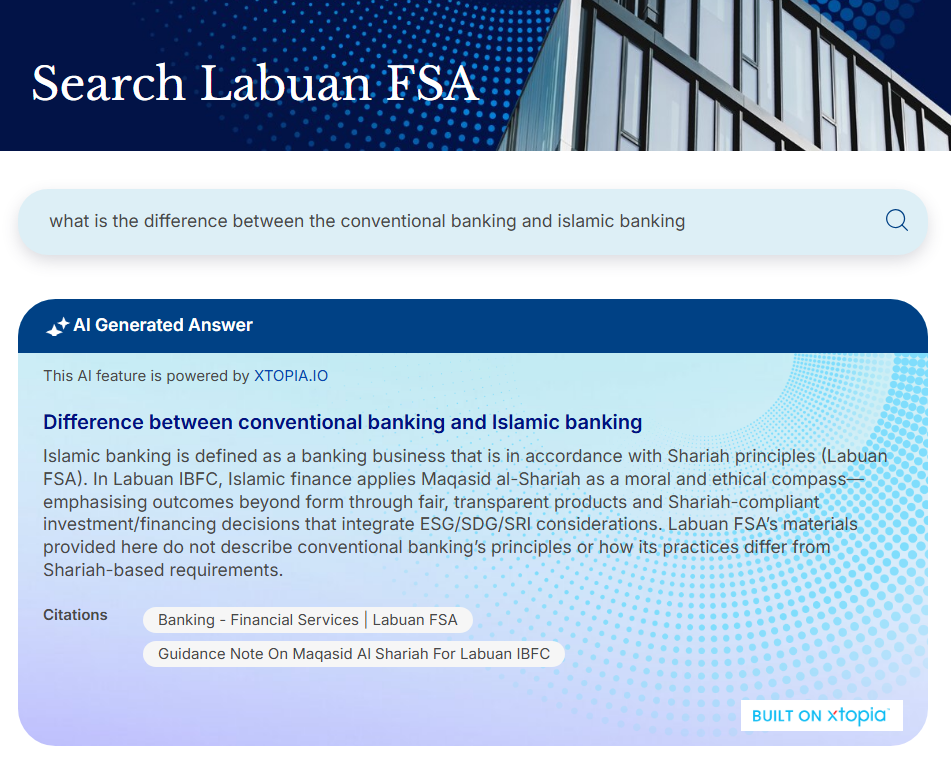
Natural language search response with XTOPIA Smart Search

3. AI Summary: respect your reader's time

Long content is valuable, but it's intimidating. Reports, policy documents, research articles and terms of service all hide their key points under a lot of text.

XTOPIA's Content Summariser uses large language models to generate concise summaries and highlight what matters most. It goes further than summarising: readers can ask follow-up questions about the content, or select a specific passage and ask about just that section. It can also be fine-tuned for specific domains so summaries stay contextually appropriate. A summary can also encourage people to keep reading rather than bounce.

This feature will be best used on publishers, financial and regulatory content, research, news and long-form guides.

4. AI Content Reader: turning content into an interactive e-book (custom build)

Imagine a long whitepaper that isn't a PDF but an interactive reading experience. Each chapter opens with a summary. The reader can jump to what's relevant to them, ask questions of any chapter, and get a recap of what they've covered. Content stops being a document to download and becomes something to engage with.

This combines XTOPIA's summarisation, conversational and content capabilities into a bespoke experience built around your material.

AI Content Reader works great for guides, annual reports, course materials, product manuals, member handbooks.

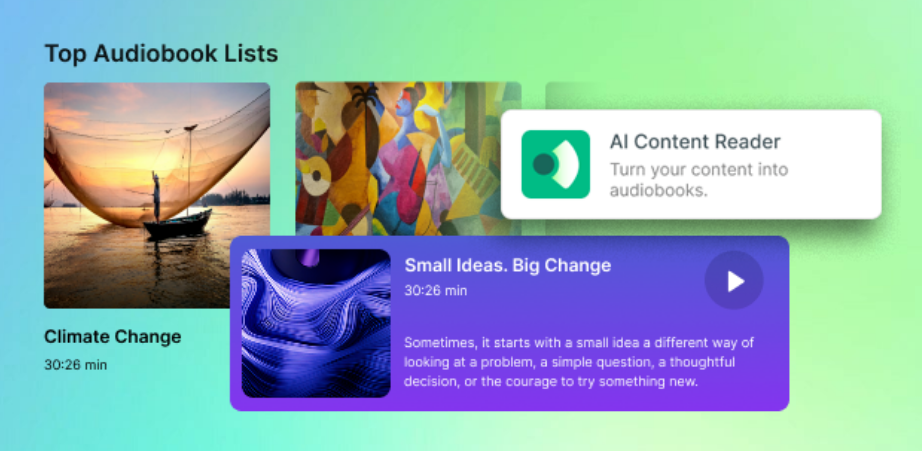
XTOPIA AI Content Reader Preview

Illustrative Sample: The 40-page regulatory update

A financial services firm publishes a detailed regulatory guide for clients. It's authoritative, and almost nobody reads it end to end.

Before: Visitors skim the first page, panic at the length, and leave. Or they download it and never open it.

After: The page now opens with an AI Summary: five key takeaways in plain language. A reader curious about one clause selects the paragraph and asks, "What does this mean for a small business?" The answer appears right there, based on the document. For readers who want the whole thing, an AI Content Reader version breaks it into chapters with recaps and Q&A.

The result: More people understand the content and more of them act on it. The firm shows expertise instead of just publishing it.


More ideas worth considering

Once the foundations are in place, the possibilities grow quickly, and this is where a custom build starts to pay off. One of the most useful is personalised recommendations: a visitor describes their situation in their own words, and the site suggests the right product, package or programme instead of leaving them to compare options on their own.

Closely related is the guided conversational form. Instead of facing a long, intimidating form, the visitor answers one question at a time while the AI adapts to each response, an approach XTOPIA's Form Creator tool supports. Behind the scenes, your team can use XTOPIA's Content Composer to draft on-brand content faster, so the website keeps growing without the usual bottleneck.

Other ideas extend how people can interact with your site. Voice conversation, which XTOPIA's agents already support, makes the experience more accessible and more natural for visitors who are on the move or simply prefer speaking to typing. Multilingual assistance lets you serve visitors in their own language from the same underlying content.

For sales-driven sites, agents can qualify leads, capture contact details and sync with your CRM or calendar, so promising enquiries never go cold. And perhaps the most underrated benefit is what you learn from all of this: the questions visitors ask form a map of what they care about, and the ones your website can't yet answer show you exactly which content to create next.

The shift from content to conversation

The three examples above have more in common than they first appear. In each one, the visitor asks in their own words rather than having to learn how your website is organised. The answers come from your own content, because the AI retrieves and reasons over what you've published instead of improvising. The experience also adapts to the person, with summaries, search results and recommendations that fit their situation rather than an average visitor's. Finally, every interaction ends with a clear next step, whether that's a booking, an enquiry, a download or a smooth handover to a human team member.

This approach also supports your AEO and GEO efforts. Content that is clear, well structured and genuinely useful serves your human visitors and the AI systems that now surface and cite web content, so the same effort feeds both. In other words, you're not choosing between optimising for people and optimising for machines. Making your website easier to ask questions of makes it easier to understand for everyone.
What about accuracy, privacy and control?

These are exactly the right questions to ask, because AI that makes things up or mishandles data is worse than having no AI at all. XTOPIA's approach tackles accuracy first by grounding its agents in your own content and documents, so answers come from what you've actually published rather than guesses drawn from the open internet. This retrieval-based method is what keeps responses relevant, specific to your business and consistent with your brand.

On privacy, XTOPIA states that your data and methodology remain private and are not used to train AI models, and that all interactions are secured. For organisations handling sensitive information, personal data can also be masked before it reaches a language model, which helps with compliance requirements such as PDPA. Control stays with your team throughout: agents are designed with auditable action logs and human escalation points, so complex or sensitive matters can be handed to a person with the full conversation attached.

And because you don't need a large technical team or a rebuilt website, with Smart Search plugging into your existing platform and agents installing through a simple code snippet, you can start small, see how it performs and expand with confidence.
Where to start

You don't have to do everything at once. Most organisations get the best results by starting small:

Look at your visitors' questions. What do people ask most often by email, chat or phone? What do they search for and fail to find?

Pick one high-friction spot. A confusing search, a long document or a flooded enquiry inbox.

Choose the matching tool.
Enquiries and bookings call for an AI Agent. Hard-to-find content calls for Smart Search. Long content calls for AI Summary.

Launch, learn and expand.
Let real conversations tell you what to build next.
Ready to make your website work harder?

Your website is no longer just a page people read. It's a place people expect to talk to. XTOPIA helps you get there with AI Agents, Smart Search, Content Summariser, and custom experiences built around your content.

XIMNET is a digital solutions provider with over two decades of experience specialising in web application development, AI solutions and system integration. XIMNET’s XTOPIA platform helps businesses create smarter digital experiences with AI-powered capabilities. Get in touch with us to find out more.
about the AGENCY
XIMNET is the leading AI agency for Enterprise AI Agents in Malaysia.
Get In touch

Make an appointment to learn how to apply AI right for your organisation.


other good reads
Deliver real results
XIMNET Malaysia SB is a leading AI company in Malaysia with over two decades of expertise in web design, digital communication, and technology innovation. We help businesses, educational institutions, and enterprises leverage AI-powered solutions, intelligent automation, website development, and digital engagement strategies to improve customer experience, operational efficiency, and business growth.
XIMNET is an OpenAI Partner in Malaysia
XIMNET is a Certified Microsoft Solution Partner in Malaysia
XIMNET is an Malaysia Digital certified digital agency
Copyright 2026 © XIMNET MALAYSIA SDN BHD (516045-V). 

All rights reserved   |  Privacy Policy  |  Get in Touch  |  Employee Code of Conduct  |  Powered by XTOPIA
Ooops!
Generic Popup2