While search engines like Google remain an important way for people to discover websites, more users are now turning to AI tools like ChatGPT, Gemini and Perplexity to ask questions and find information. As a result, businesses are starting to hear new terms such as SEO, AEO and GEO. But what do they actually mean, and do you need all three?
For years, Search Engine Optimisation (SEO) has been the foundation of improving a website's online visibility. If someone searched for a product or service, the goal was simple: rank higher in search results so more people would click through to your website.
Today, the way people discover information is changing.
Instead of typing a few keywords into a search engine, many users are asking complete questions through AI assistants. Whether it's comparing software, looking for recommendations or learning something new, people increasingly expect direct, conversational answers instead of a long list of links.
This doesn't mean SEO is becoming obsolete. Rather, it means businesses should start thinking beyond traditional search rankings. That's where AEO and GEO come in.
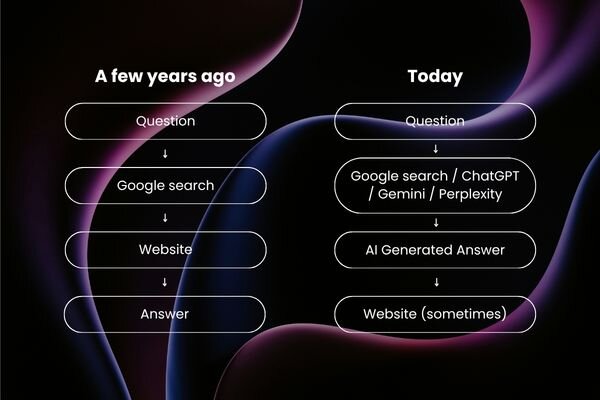
Although these terms are often mentioned together, each focuses on a different part of how people discover information online.
SEO (Search Engine Optimisation)
SEO is the practice of improving your website so it appears more prominently on search engines like Google and Bing. It involves creating valuable content, using relevant keywords, building a technically sound website and earning credibility over time.
The goal is straightforward: make it easier for people to find your website when they're actively searching for information, products or services.
Think of it as: Helping people find your website through search engines.
AEO (Answer Engine Optimisation)
Answer Engine Optimisation (AEO) focuses on making your content easy for AI-powered search experiences and answer engines to understand and present as direct responses.
Instead of optimising only for rankings, AEO encourages businesses to answer questions clearly, organise information logically and write in a way that's easy for both people and AI to understand.
For example, if someone asks an AI assistant, "What is cloud hosting?", well-structured content with a clear explanation has a better chance of being surfaced as part of the answer.
Think of it as: Helping AI answer users' questions using your content.
GEO (Generative Engine Optimisation)
Generative Engine Optimisation (GEO) goes one step further. Rather than focusing on a single answer, GEO is about helping AI platforms recognise your website as a credible and trustworthy source of information.
Generative AI doesn't simply copy content from one webpage. Instead, it gathers information from multiple trusted sources before generating a response. Websites that demonstrate expertise, accuracy and authority are more likely to contribute to those AI-generated answers.
Think of it as: Helping AI recognise your website as a trusted source of information.
While SEO, AEO and GEO each have different goals, they aren't competing strategies. Think of them as working together to help your website stay discoverable across both traditional search engines and AI-powered search experiences.
SEO
AEO
GEO
Main goal
Improve visibility in search engine results
Help AI provide direct answers
Help AI understand and trust your content
Suited for
Search engines
AI answer engines & AI Overviews
ChatGPT, Gemini, Perplexity and other generative AI platforms
Focus
Keywords, technical SEO and quality content
Clear answers, FAQs and structured content
Authority, credibility and context
Outcome
More organic traffic and website visits
Your content appears in AI-generated answers
Your content is recognised as a trusted source by AI
Approach
Helping people find your website
Helping AI answer questions
Helping AI trust your expertise
Businesses don't need to choose one over another. A strong website combines the foundations of SEO with content that's clear enough for AI to understand and trustworthy enough to reference.
The good news is that preparing for AI search doesn't mean rebuilding your website from scratch. Many of the fundamentals of good SEO still apply. The difference is that your content now needs to work well for both people and AI systems.
1. Answer Real Customer Questions
Create content that answers the questions your customers are already asking.
Do
Don't
Add FAQ sections and helpful guides
Focus only on keywords
Write in natural, conversational language
Fill pages with generic promotional copy
2. Structure Your Content Clearly
Well-organised content is easier to read and easier for AI to understand.
Do
Don't
Use clear headings and short paragraphs
Publish long walls of text
Use bullet points or tables where helpful
Use vague or unclear headings
3. Demonstrate Your Expertise
Original insights and real experience help build trust with both readers and AI.
Do
Don't
Share practical examples or case studies
Rely entirely on generic AI-generated content
Support key claims with reliable sources
Make unsupported claims
4. Keep Your Content Up to Date
Accurate and current information is more valuable for both users and AI systems.
Do
Don't
Review and update important pages regularly
Leave outdated information on your website
Refresh statistics, examples and product details
Assume content never needs updating
5. Maintain Strong Technical SEO
A technically healthy website provides a better experience for users while making it easier for search engines and AI systems to access your content.
Do
Don't
Optimise page speed and mobile responsiveness
Ignore technical issues or broken links
Keep your website well organised
Publish duplicate or incomplete pages
Ultimately, preparing your website for AI search is not about creating content for machines alone. It is about creating a better digital experience, one that helps people find the information they need while allowing AI systems to better understand and reference your content.
Search isn't what it used to be, and that's not necessarily a bad thing.
Whether someone discovers your business through Google, an AI assistant or whatever comes next, the goal remains the same: create content that's useful, trustworthy and easy to understand.
SEO continues to provide the foundation. AEO helps your content answer questions more effectively, while GEO helps establish your website as a reliable source that AI can understand and reference.
The technology will continue to evolve, but one thing is unlikely to change: businesses that put people first and create genuinely valuable content will always have the advantage.